Global Hip Thrust Equipment Manufacturing & Sourcing Intelligence
1. Executive Summary: The Structural Boom of Glute-Focused Strength Machinery
Over the past decade, global commercial fitness procurement strategies have experienced a fundamental paradigm shift. Historically treated as an auxiliary or specialized accessory exercise, gluteus maximus training—specifically executed via the barbell hip thrust and dedicated plate-loaded hip thrust machines—has surged to become a cornerstone of both athletic performance programming and commercial fitness club offerings. Procurement data across North America, Europe, and Asia-Pacific indicates that dedicated glute training apparatuses now rank among the top 5 highest-utilized machines per square foot in modern commercial gyms, collegiate strength facilities, and tactical conditioning centers.
For fitness brand owners, equipment distributors, and commercial facility procurement managers, selecting an experienced OEM/ODM Hip Thrust Machine Factory is no longer merely a purchasing decision; it is a long-term capital asset strategy. Conventional free-weight barbell thrusts present operational challenges for commercial gym operators, including floor damage, setup inefficiency, risk of heavy barbell slippage, and improper lumbar spine stabilization. Purpose-engineered commercial hip thrust machines solve these issues by delivering targeted resistance curves, integrated pelvic belt restraints, elevated backrest pivots, and ergonomic footplate positioning.
Engineering & Biomechanical Development Trends (2025–2030)
As a leading strength equipment exporter and contract manufacturer, our engineering team continuously audits machine kinematics, structural metallurgy, and mechanical failure points. Modern commercial hip thrust equipment design focuses on key technical evolutions:
Variable Resistance Cam Kinematics
Standard leverage pivot arms often result in dead spots at maximum hip extension. Advanced ODM designs utilize variable eccentric cams or multi-linkage leverage arms that match the human muscle torque curve, ensuring maximal resistance at full glute contraction.
Dual-Axis Pelvic & Lumbar Stabilization
To prevent spinal hyperextension, next-generation hip thrust machines feature self-adjusting back pads with high-density, multi-layer polyurethane foam. Padded quick-release safety belts lock the athlete’s pelvis firmly against the pivot axis without restricting range of motion.
Heavy-Gauge Steel Fabrication
Institutional environments demand structural integrity. OEM specifications require minimum 3" x 3" (75 x 75 mm) or 50 x 100 mm structural steel tubing with 11-gauge (3.0 mm) wall thickness, capable of supporting static loads exceeding 500 kg (1,100 lbs).
Plate-Loaded vs. Selectorized Cable Hip Thrust Systems: Architectural Comparison
When requesting OEM manufacturing quotes, buyers must evaluate the operational trade-offs between plate-loaded leverage machines and selectorized pin-selected cable stack units.
Plate-Loaded Leverage Systems: Offers low mechanical complexity, virtually zero cable maintenance, higher weight capacity for high-performance collegiate and professional strength facilities, and lower overall OEM unit production cost.
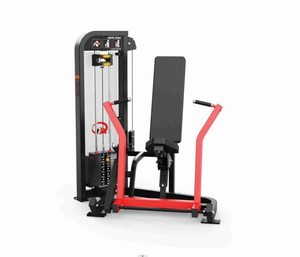
Selectorized Cable-Stack Systems: Provides instant resistance adjustments via magnetic selector pins, consistent cable-driven linear resistance, smaller footprint footprint efficiency, and optimal access for general commercial fitness gym members and rehabilitation centers.
Hybrid Resistance Designs (Band Peg Integration): Modern ODM factories integrate dual stainless steel band pegs into the base frame, allowing athletes to combine progressive elastic band tension with traditional weight plate load.
Future Procurement Trends for Global Gym Equipment Buyers (2025–2030)
As commercial fitness chains expand globally and regional distributors seek private-label dominance, purchasing departments must adapt to changing supply chain dynamics:
Agile White-Labeling & Rapid Prototyping
Leading OEM exporters now provide turnkey customization—including laser-cut brand plates, custom frame powder coat matching (RAL colors), dual-tone custom embroidered upholstery, and custom rubberized end-cap tooling with short lead times.
EN ISO 20957 & ASTM Structural Compliance
Strict international safety regulations require commercial strength equipment to pass rigorous cyclic stress testing (over 100,000 repetition cycles under full dynamic payload) and salt-spray corrosion resistance tests (240+ hours) prior to export.
Knock-Down (KD) Packaging Efficiency
With ocean freight volatility, advanced ODM engineering emphasizes modular Knock-Down (KD) frame structures. Flat-pack palletizing maximizes container load density (CBM optimization), drastically reducing landed shipping costs per unit.
Why Institutional Buyers & Global Brands Partner With Us
Rooted in decades of heavy-duty commercial equipment manufacturing excellence, our state-of-the-art facility bridges high-end structural engineering with flexible international OEM/ODM export services.
Factory-Direct Manufacturing Control
From raw Q235 steel tube cutting, 3D laser profiling, automatic robotic seam welding, to double-pass electrostatic powder coating and hand-stitched commercial upholstery, every manufacturing step is conducted under one roof for absolute quality control.
End-to-End Turnkey Customization
We transform hand sketches or CAD concepts into production-ready physical units. Whether you require custom frame geometry, specialized weight stack ratios, or branded shroud wraps, our in-house R&D team delivers prototype samples in as fast as 15 days.
Turnkey Facility Layout & CAD Support
We don't just supply equipment; we assist commercial distributors and gym owners with 2D/3D floor plan layout design, station spacing optimization, and athlete workflow mapping to maximize facility throughput and training safety.
Direct answers to essential technical, logistics, and customization queries from international procurement managers and fitness equipment importers.
1. What is the standard Minimum Order Quantity (MOQ) for OEM/ODM Hip Thrust machines?
+
Our standard OEM MOQ is 10 units per specific model for custom color combinations and basic brand badging. For complete custom tooling or bespoke structural engineering (ODM projects), MOQ typically starts at 20 units or a mixed full container load (20GP / 40HQ) combined with our power racks, weight benches, and selectorized machines.
2. How do your factory quality control systems ensure structural integrity under commercial use?
+
Every structural frame undergoes 100% full-penetration robotic MIG welding inspection. Finished frames are dynamic load tested up to 1.5x maximum rated capacity (750 kg load test). Furthermore, critical pivot points utilize heavy-duty Japanese NSK/SKF sealed bearings to ensure zero wobble and friction-free rotation across millions of cycles.
3. What custom branding options are available for private-label distributors?
+
We offer comprehensive white-labeling solutions: 3D laser-cut stainless steel logo badges, custom silk-screened acrylic weight stack shrouds, high-relief vinyl frame transfers, custom embossed or embroidered leather pads, laser-etched stainless steel reference plates, and customized export carton packaging with your brand logos and barcodes.
4. What surface treatment process is used to prevent rust and chipping?
+
Our metal pre-treatment consists of a multi-stage automated shot blasting process to remove all mill scale and oxides, followed by a phosphate wash. Frames then receive a dual-coat thermosetting electrostatic powder coating (primer coat + thermoset polymer color coat) baked at 200°C (392°F). This yields superior impact resistance and passes 240-hour salt spray corrosion testing.
5. What are the typical production lead times for bulk container exports?
+
For standard commercial production runs, lead times are 30 to 45 calendar days after deposit approval and artwork confirmation. Rapid-ship OEM samples for prototype evaluation can be completed within 15 to 20 days.
6. How are machines packaged to prevent freight damage during ocean transport?
+
All components are individually wrapped in anti-scratch EPE foam sheets, shrink-wrapped, and fortified with heavy corner protectors. Units are packed into multi-wall corrugated master cartons and reinforced on fumigated plywood pallets with steel strapping to withstand heavy container handling and international transit.
7. Can you provide custom structural modifications for specialized training facilities?
+
Yes. Our engineering department operates SolidWorks 3D CAD and finite element analysis (FEA) software. We can adjust frame length, footplate angle, pin-loaded weight stack increments, pad thickness, or add custom band peg attachments according to your program specifications.
8. What warranty coverage is provided for commercial procurement orders?
+
We back our strength equipment with a comprehensive commercial warranty: 10 Years on structural steel frames, 2 Years on rotary bearings, guide rods, and weight stacks, and 1 Year on cables, linear bearings, rubber grips, and upholstery padding. Replacement spare parts are shipped rapidly via air express for minimal downtime.
Partner With A World-Class Strength Equipment OEM/ODM Manufacturer
Whether you are expanding your commercial gym equipment line, upgrading an institutional athletic facility, or seeking a reliable contract manufacturing exporter, our team is ready to deliver precision engineering, competitive factory pricing, and full white-label support.